The Last Mile: fixing the wrong incentives
A browser game about shipping AI products, built and tested in six days. Play the game
Built with Claude Code (code and simulations), ChatGPT (illustrations) and Suno (music).
- The claim
- I checked all 2,187 decision paths in each story under the revised rules. The 20 best launches are all wins with high Judgment, and every path with Judgment under 65 ends at “Lucky break” at best.
- What supports it
- The simulation of the current rules. Before it, Astra, an AI tester running on GPT-6, scored 100/100 in 12 of 12 runs by taking shortcuts. Astra played blind, without knowing the scoring rules, across several stories.
- What a practitioner said
- A senior product leader played it about ten times, through to the end. They found it engaging and saw real value in it for onboarding new product managers and for training. In this version, they said, entertainment outweighs the educational layer. With a stronger educational layer, they would recommend it to ten PMs.
- Scope and limits
- That players learn, or that no strategy can beat the scoring. I believe the new scoring teaches trade-offs, because a win needs both scores, but whether players learn has not been measured. So far: a small number of human testers and one AI tester.
Two decisions
Decision 1How do we score a run?
Every choice moved a single number. A game meant to teach responsible building was rewarding the opposite.
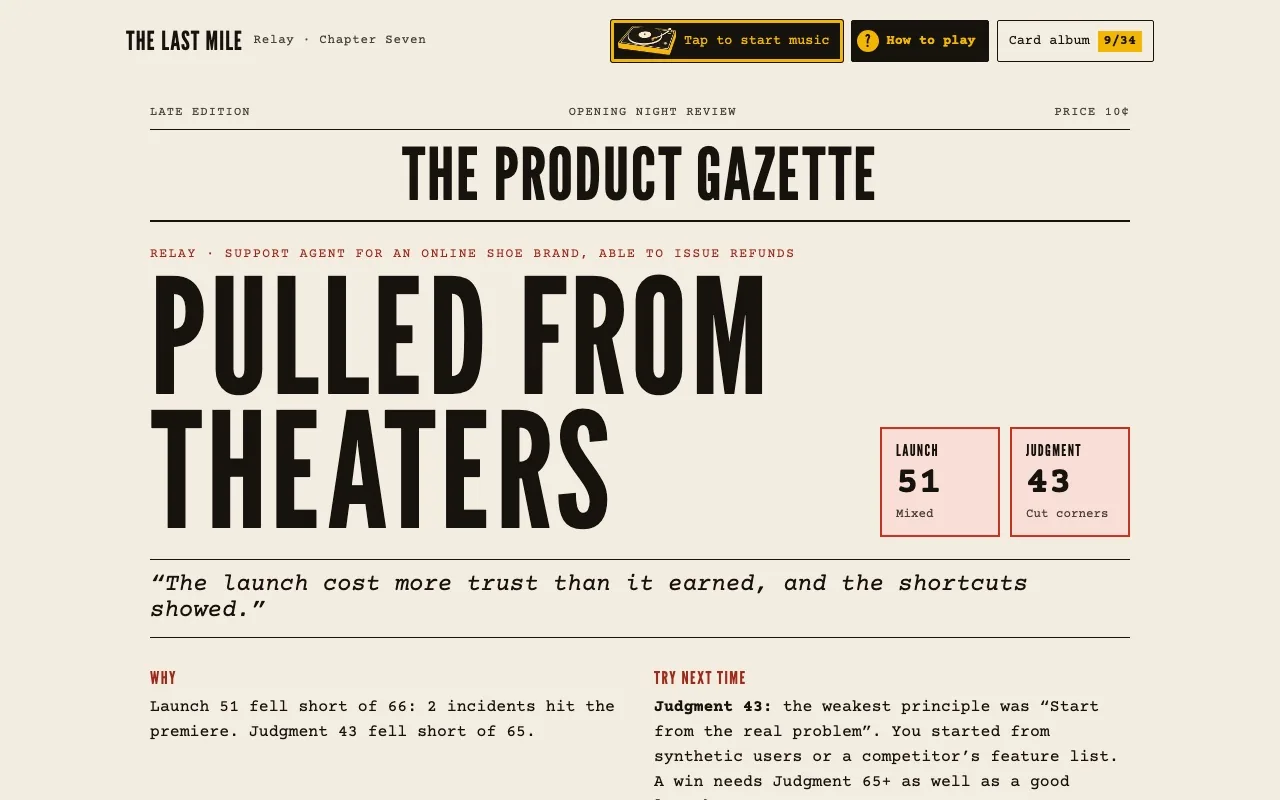
Launch measures how the product did. Judgment measures seven principles of responsible AI. A win needs both to clear the bar.
Astra won every run by taking shortcuts: benchmark scores instead of evaluating with clinicians, and a big launch across 40 clinics at once. A human tester had also said that 100 was undeserved: “max 70.”
There are four endings, and only one is a win. I rebuilt scoring, onboarding and navigation the same day.
Decision 2What do we show the player?
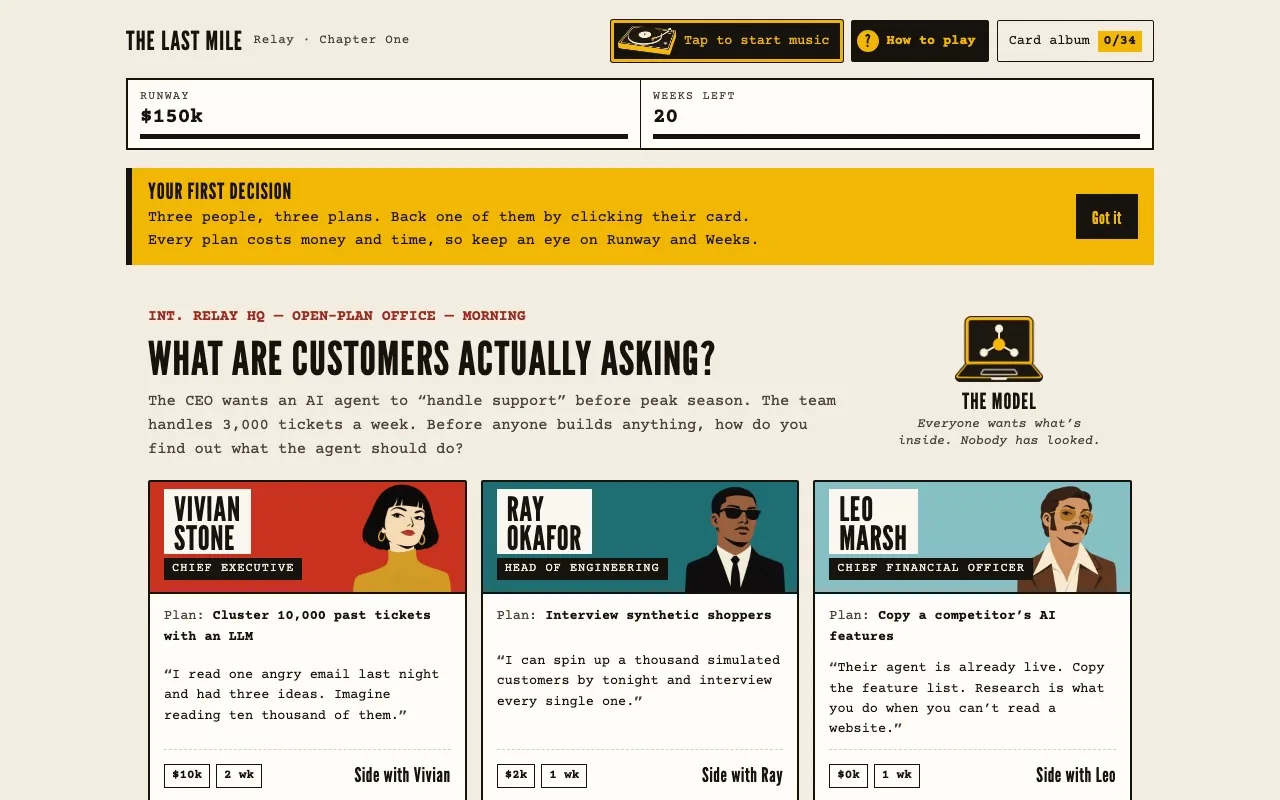
The cards pointed at the solution.
Never which card solves which.
The tester who scored 100 had learned to pick the right cards. Matching a technique to a problem is the actual job.
Where patients carry the risk, launching everywhere at once now scores “partly” at best, even with evals.
What a player sees
Six days
- Playable, but dry. You are the PM and back one colleague’s plan per chapter. I rebuilt it as a 1970s film poster.
- A success signal first. Before anyone played, I set the bar: does a tester start a second run unprompted?
- Signal met, start too hard. One tester replayed three times, scoring 64, 59 and then 100, and called the start “super complicated”. As far as I can tell they replayed out of interest and to crack the mechanics. That shows engagement with the game, not that they learned.
- The metric breaks. Astra scored 100/100 in 12 of 12 runs.
Next
A new version with a stronger educational layer and a landing page, then round 3 with people and a rerun with Astra on the new scoring to see whether an AI can still find a shortcut.